A QUESTION TO START WITH
The first-job poll
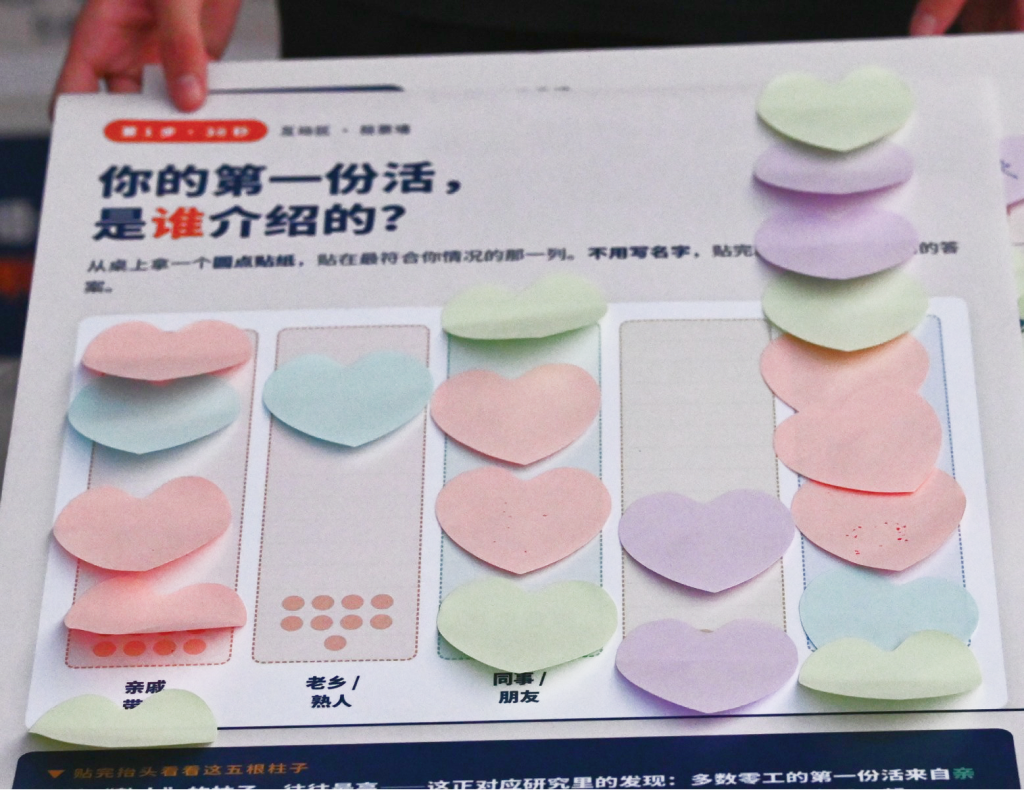
I asked a familiar question: who introduced you to your first job?
Explore the first-job pollHEIWUN LUO / A PERSONAL PROJECT
I’m Heiwun. I turned a question about gig work and opportunity into a community pop-up — using simple activities to make the ideas easier to talk about.
19 October · A small community pop-up.
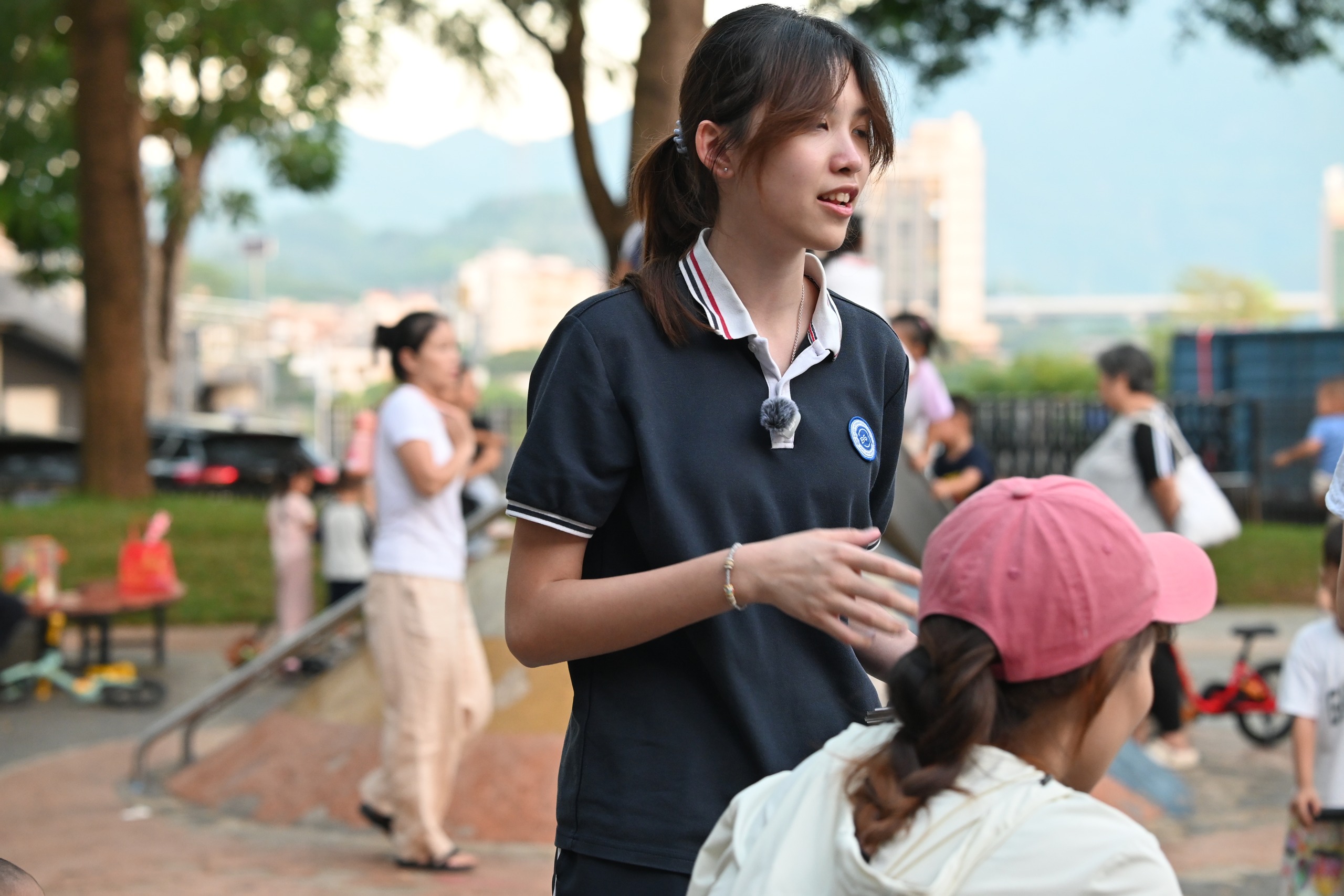
In the community, one conversation at a time.
01
A small table.
Room to stop.
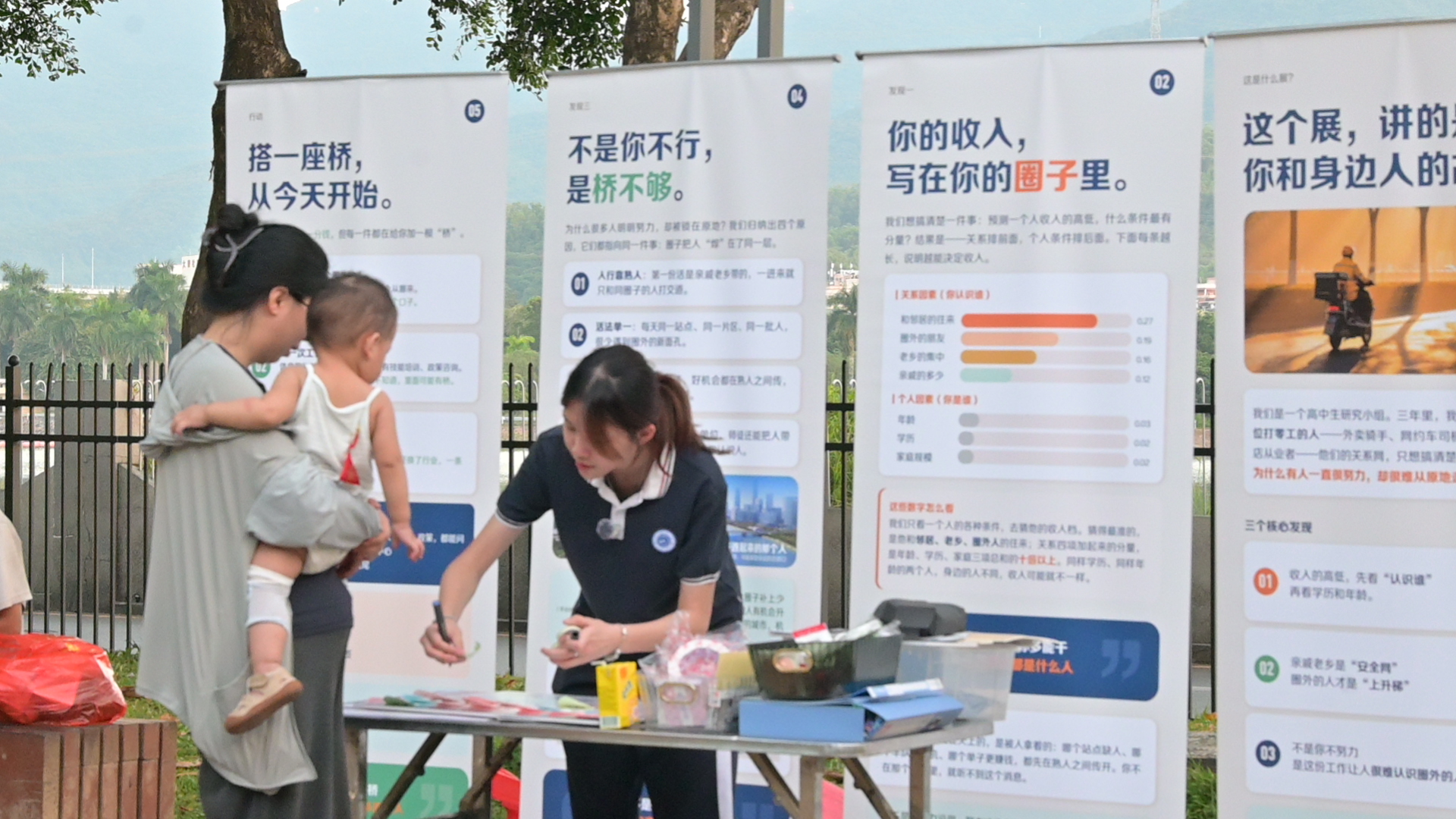
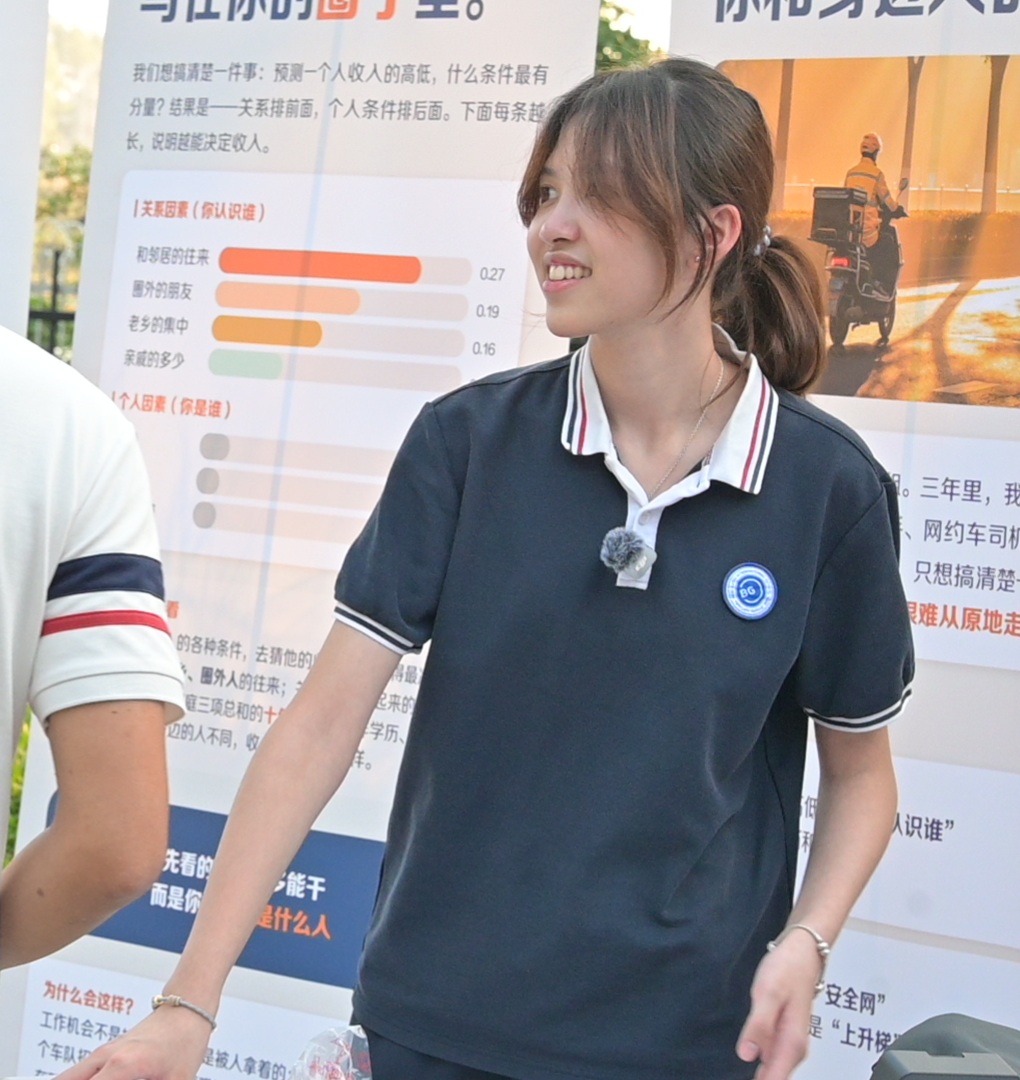
On 19 October, I brought the displays and leaflets into the community and invited passers-by to stop. I wanted a way into the topic that didn’t require reading a paper.
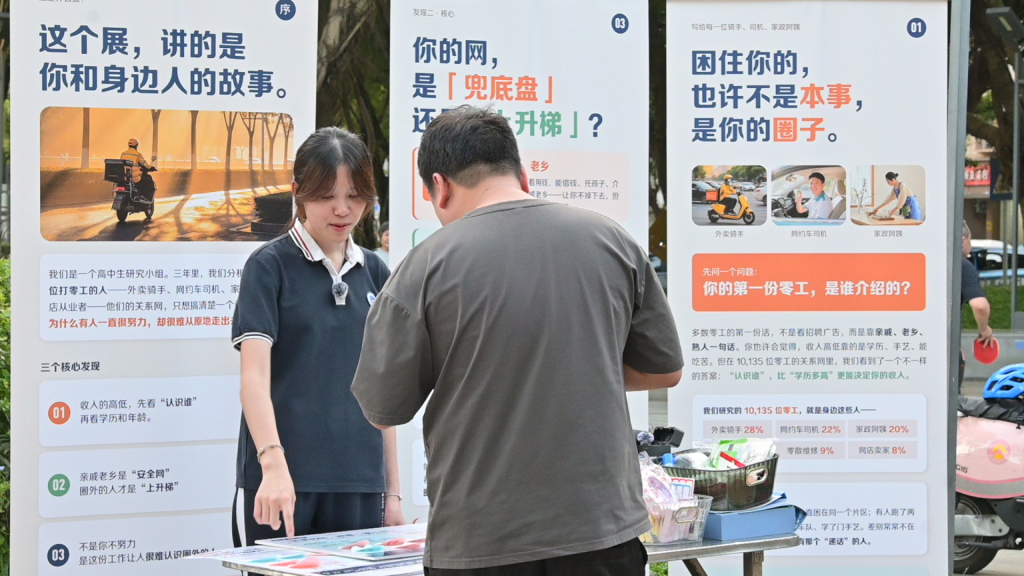
One question to begin with
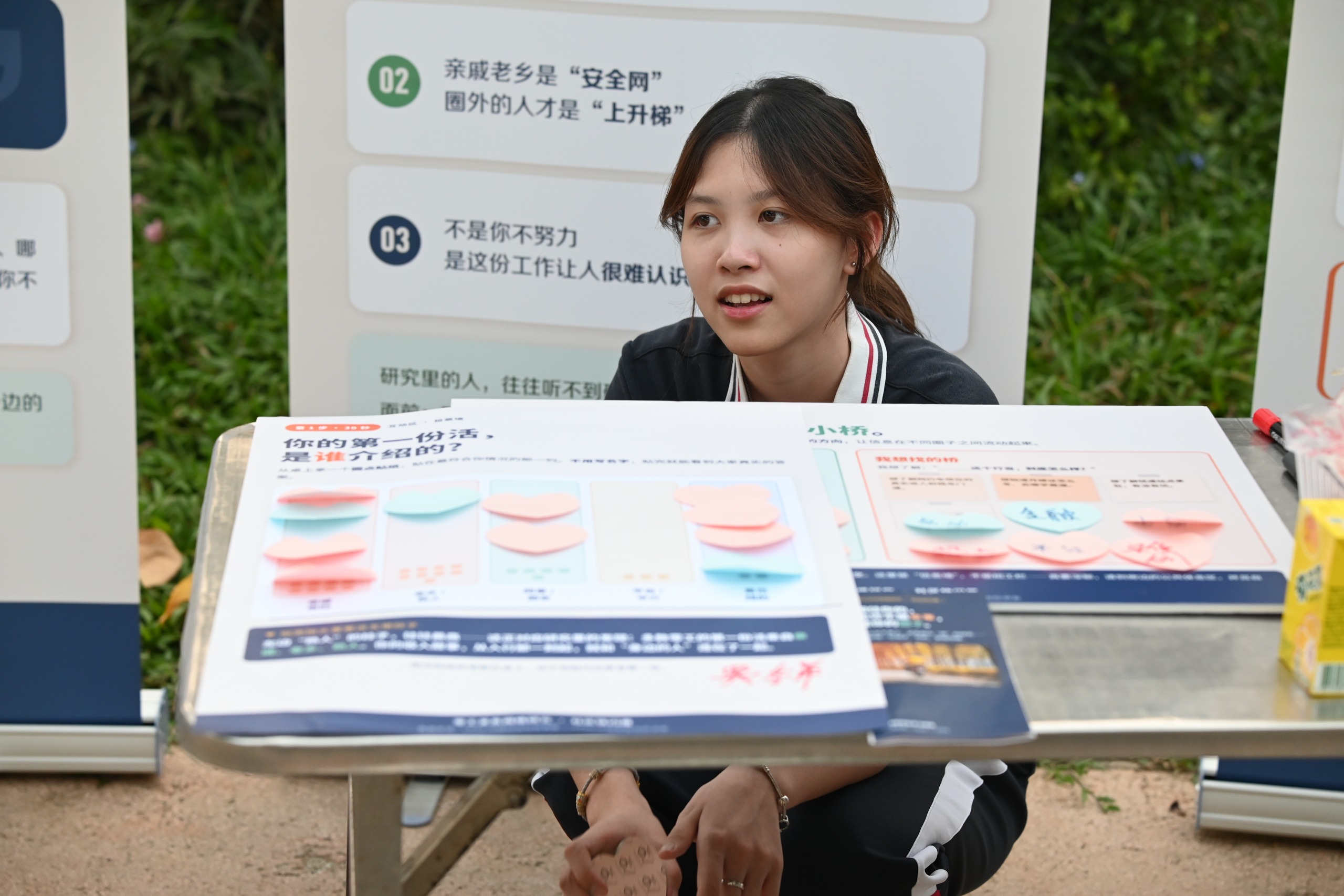
Talking through the ideas with someone who stopped by.
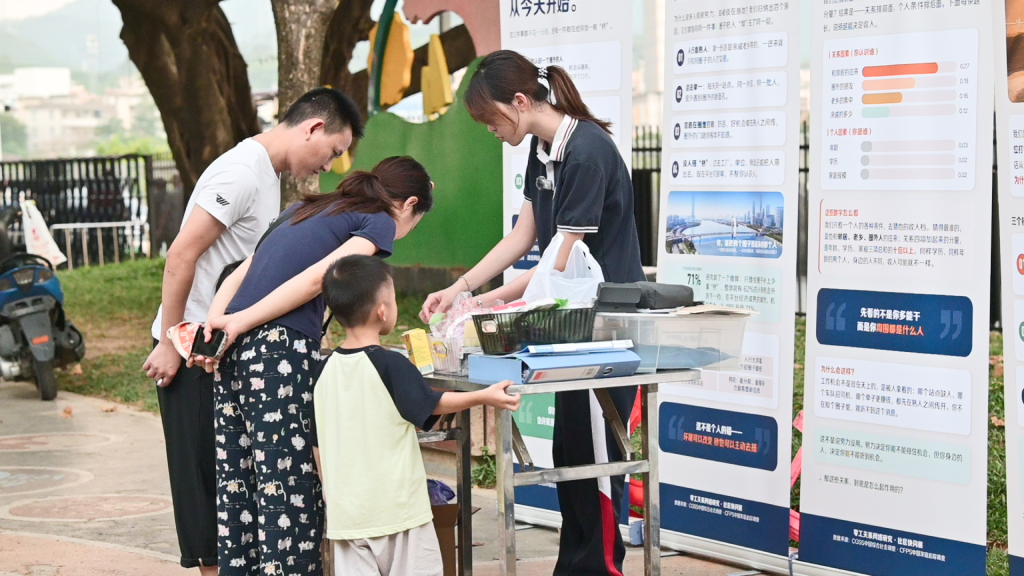
Taking a closer look
A pause at the table, and a chance to take part.
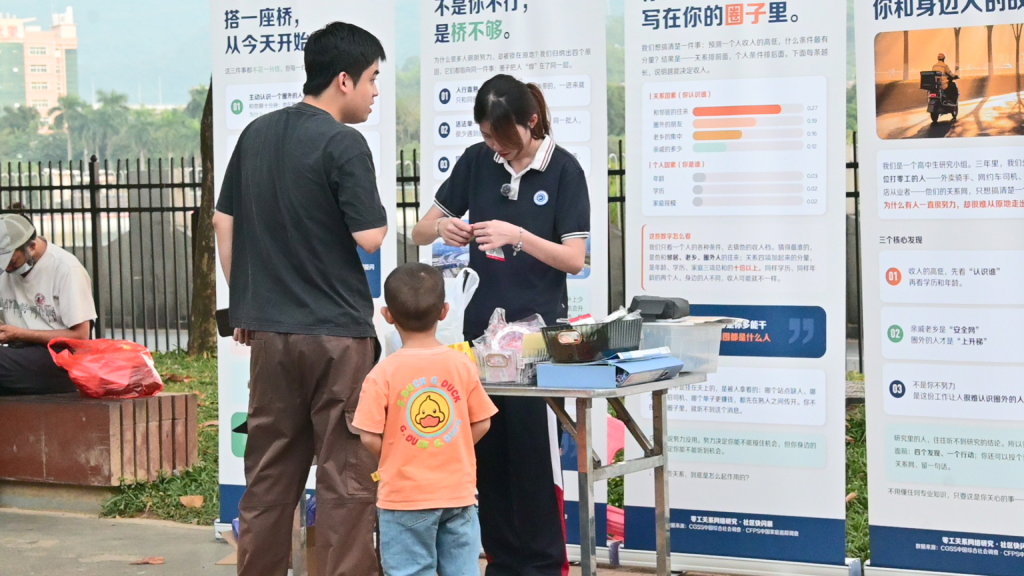
Making room at the table
The activities were open to people passing through.
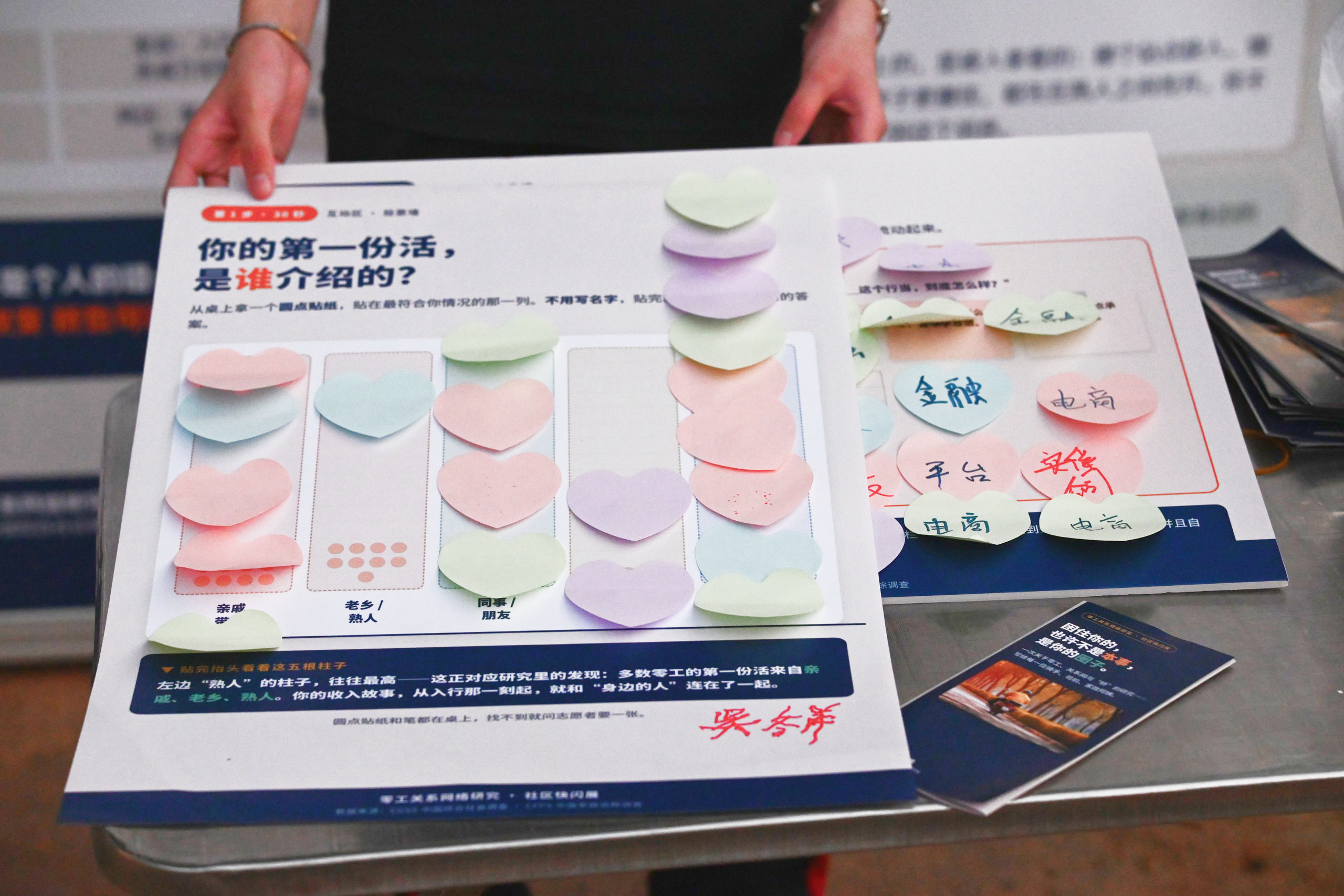
A small answer left behind
Paper, stickers and an everyday question about work.
A FEW MOMENTS FROM THE DAY · DRAG TO EXPLORE
COME ALONG FOR A MOMENT
A little of
the day.
The displays, the conversations, and the small things happening around the table.
00:24 · Sound off
Community pop-up · 19 October
A few different ways
to join in.
I wanted the table to feel easy to approach. You could look, vote, write, take a leaflet, or stay for a conversation.
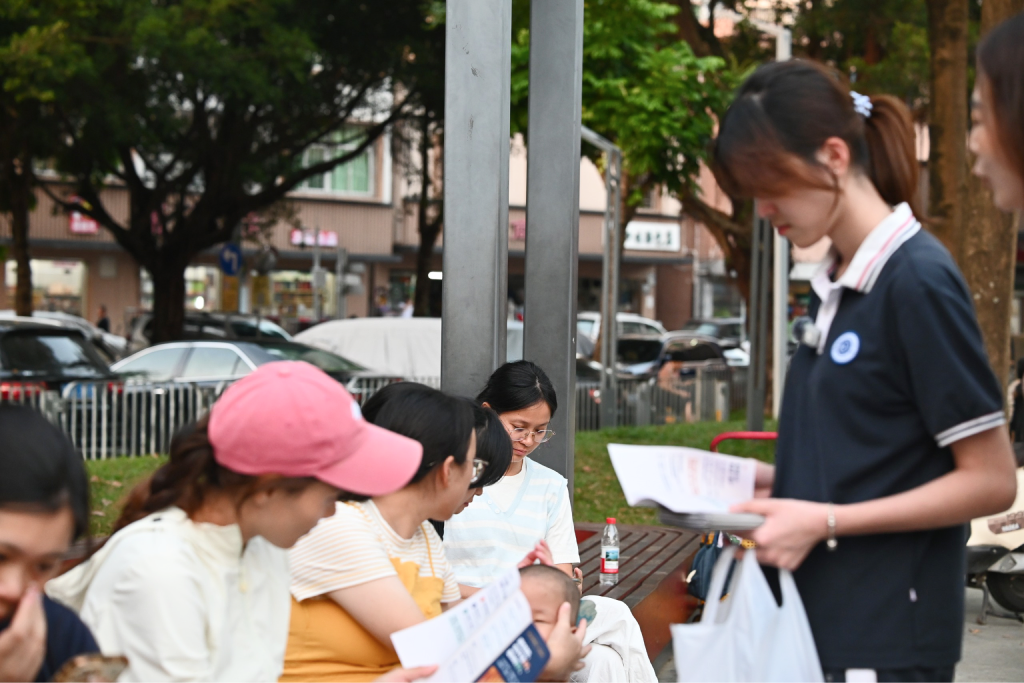
A conversation can start small.
A leaflet gave the idea a form someone could hold — and take away from the table.
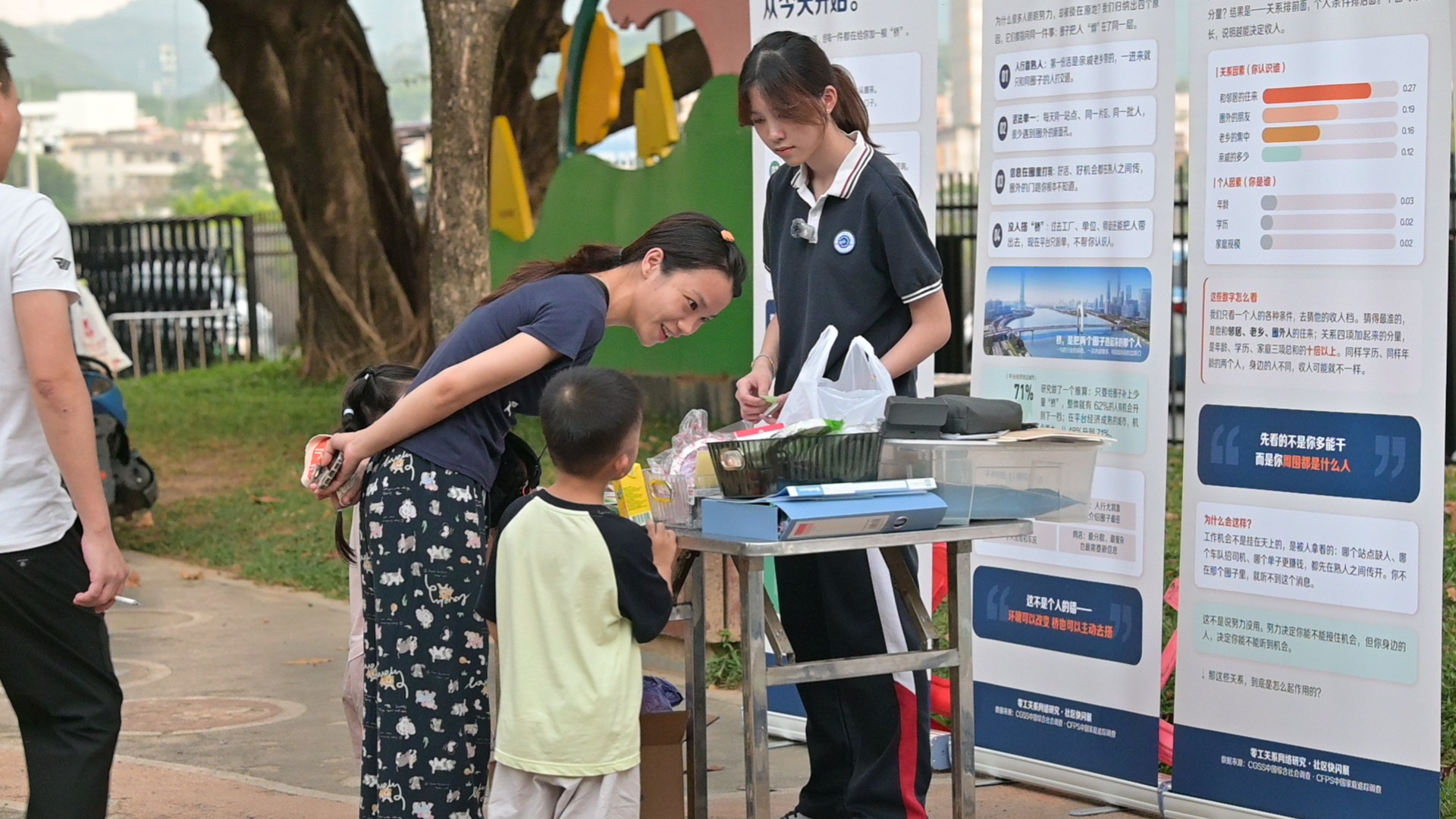
Something to try together.
Simple materials made room for a shared activity, with a question at the centre.
WHY I BROUGHT THE QUESTION OUTSIDE
The question became:
who can you reach?
The study made me look beyond a person’s qualifications to the connections around them. I wanted the pop-up to start that conversation in everyday language.
Selected attribution weights
Relational factors
0.748
Individual attributes
0.067
0
0.4
0.8
Four relational factors (0.748) compared with age, education and household size (0.067). Selected model-attribution weights; manuscript Fig. 5b. These explain model predictions, not causal effects.
02
I made it easy
to take part.
I translated a network idea into posters, a poll, a leaflet and a two-way board. Each object gave someone a familiar place to start, and a way to add knowledge of their own.
Ask
Who opened a door?
A vote about the first person who helped you find work.
Map
Who is in your circle?
A simple way to picture the people you turn to.
Take
Something for later
A leaflet with the idea and a few small next steps.
Share
Something you know
A place to offer experience, or ask about a new field.
A familiar question.
A wider circle.
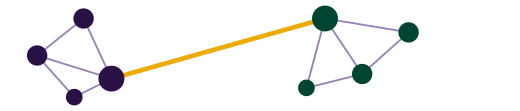
A familiar circle → a route beyond it
“Who helped you find your first job?” gave the topic a familiar starting point. I wanted people to begin with something from their own lives, then use the activities to explore the bigger idea.
The research distinguishes bonding ties, such as family and hometown links, from bridging ties across occupational or nearby networks. I translated that idea into two actions: recognise existing support, then offer or ask for knowledge beyond it.
Making space
for an answer.
The table was a place to explain, draw, write, and make the idea your own.
An idea to hold.
An invitation to connect.
I made the materials simple enough to use on the spot, with something to take away and something to leave behind.
A QUESTION TO START WITH
The first-job poll
I asked a familiar question: who introduced you to your first job?
Explore the first-job poll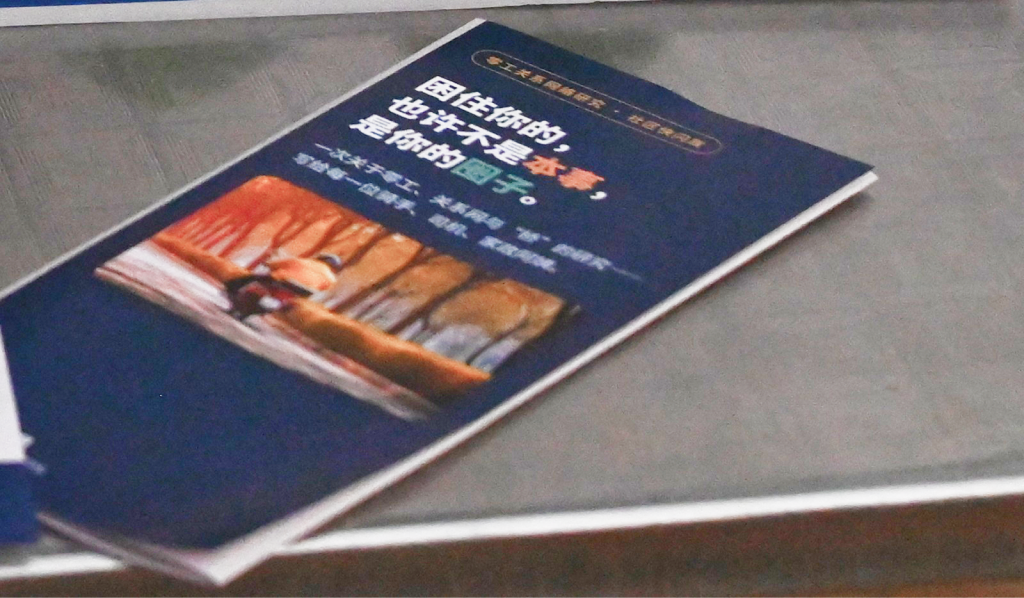
SOMETHING TO TAKE AWAY
The take-away leaflet
I put the ideas and a few practical next steps into a leaflet people could keep.
Open the leaflet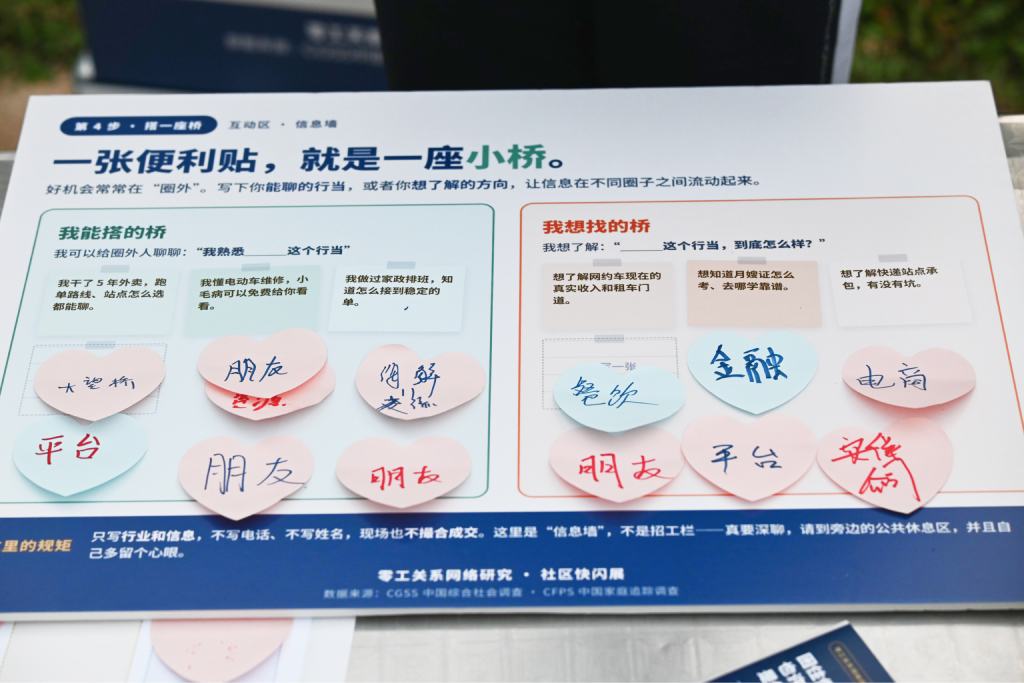
SOMETHING TO LEAVE BEHIND
The two-way bridge board
I made two spaces — one for knowledge to offer, and one for things people wanted to learn.
Explore the bridge boardI wanted each activity to feel like an invitation to join in.
03
The board had room
for more than my ideas.
I left two spaces: “what I can share” and “what I want to learn”. The handwritten notes gave the idea of a bridge a very ordinary, human form.
I wanted people to see a place for their own knowledge.
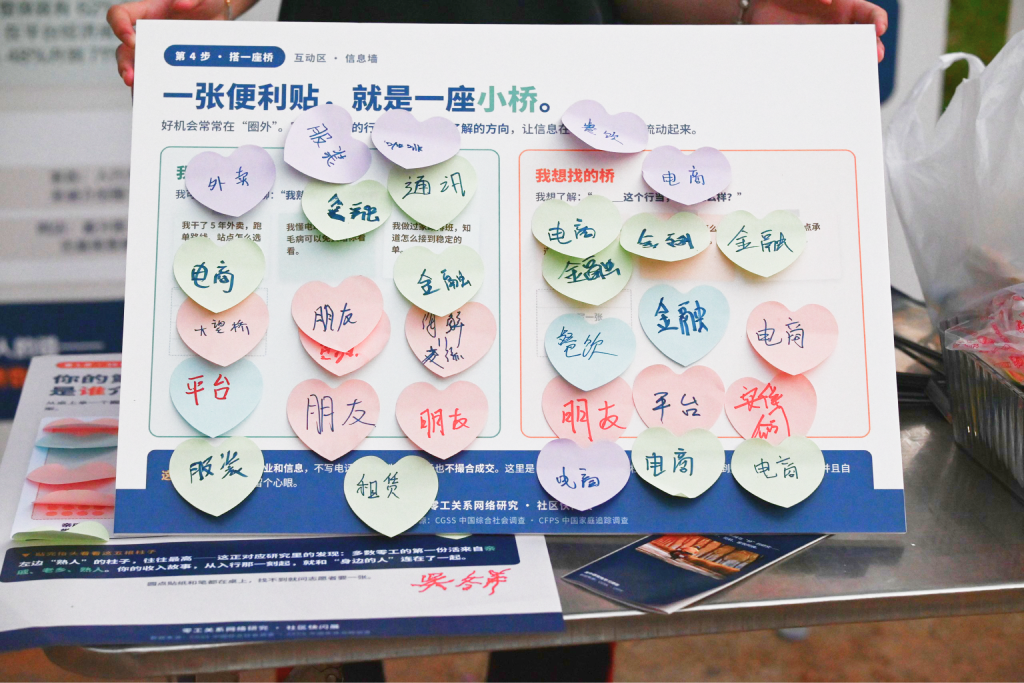
What I can share. What I hope to learn.
Words photographed on the bridge board, with English topic labels.
SOMETHING TO SHARE
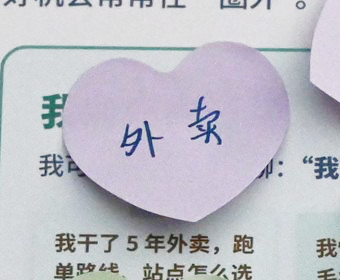
Food delivery
A subject on the “I can share” side of the board.
SOMETHING TO EXPLORE
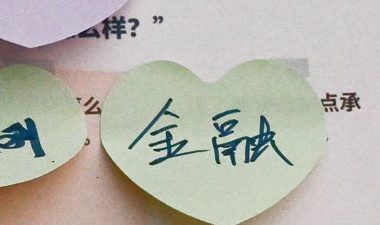
Finance
A subject someone wanted to understand better.
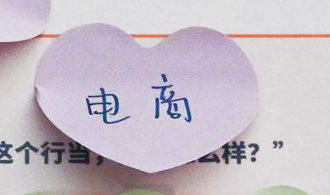
SOMETHING TO EXPLORE
E-commerce
Another starting point for a conversation.
WHAT THE STUDY MADE ME NOTICE
Support matters.
So does a way beyond it.
The low-income group had fewer bridging ties on average than the middle-and-above group. I wanted the board to offer a small opening for an exchange across fields.
Mean bridging ties per worker
Low income
3.1
Middle and above
6.8
0
5
10
Selected group means from manuscript Fig. 3b; survey-reconstructed relationships. The handwritten notes record participation in the pop-up, not a measured change in connections or income.
04
How I followed
the connections.
I began with a question about working poverty: how do the people around us shape the opportunities we can reach?
I used a graph-based model to study CGSS and CFPS data, looking at workers alongside the relationships around them.
Relationships were inferred from survey responses.
10,135
gig workers
CGSS + CFPS survey sample
63,472
modelled relationships
Inferred from survey responses
HOW I READ THE NETWORK
People, ties and time.
Four relationship types, changes across survey waves, and an explanation of which features shaped the prediction.
HOW I CHECKED THE IDEA
Read people in context.
Then test the prediction.
HR-CGNN follows four relationship types across survey waves. I compared its income-tier predictions with models that read each worker as an independent row, and with a static network model.
MODEL
MACRO-F1
LOW-INCOME RECALL
Random forest
0.652 ± 0.012
0.678 ± 0.014
GraphSAGE
0.741 ± 0.011
0.762 ± 0.011
HR-CGNN
0.789 ± 0.010
0.822 ± 0.009
Selected comparisons · five-fold means ± standard deviation. Higher is better. Manuscript Table 3.
The graph is reconstructed from surveys, and survey waves give a coarse view of change. These results support a question for practice; they do not demonstrate that the pop-up improved anyone’s income.
Read the full research manuscript →
05
Making the idea useful
is part of the work.
The part I care about is the space between understanding a problem and making it easier to talk about.
For me, this project doesn’t end with a model or a paper. I want research to become something people can recognise in their own lives — and something they can add to.
Start with a question.
Leave room for someone else’s answer.
62%
predicted tiers shifted
Under a synthetic bridging tie
A MODEL-BASED “WHAT IF”
What would it take outside the model?
Adding a synthetic bridging tie shifted 62% of model-classified low-income workers to the next predicted tier. It left me curious about what makes a new connection useful in everyday life.
Model sensitivity · manuscript §4.4. This is a direction for a future test, not an observed income effect.
A question to take
back into the world.
What would make it easier for a small exchange at this table to become a useful connection afterwards? That is the question I would bring into the next version.
THANK YOU / FOR STOPPING BY
One question.
A little further into the world.
Heiwun Luo
Curious about people, and what connects us.
Back to Yaffa’s projects →
Research background: CGSS / CFPS survey data. Model-based findings are not causal estimates.